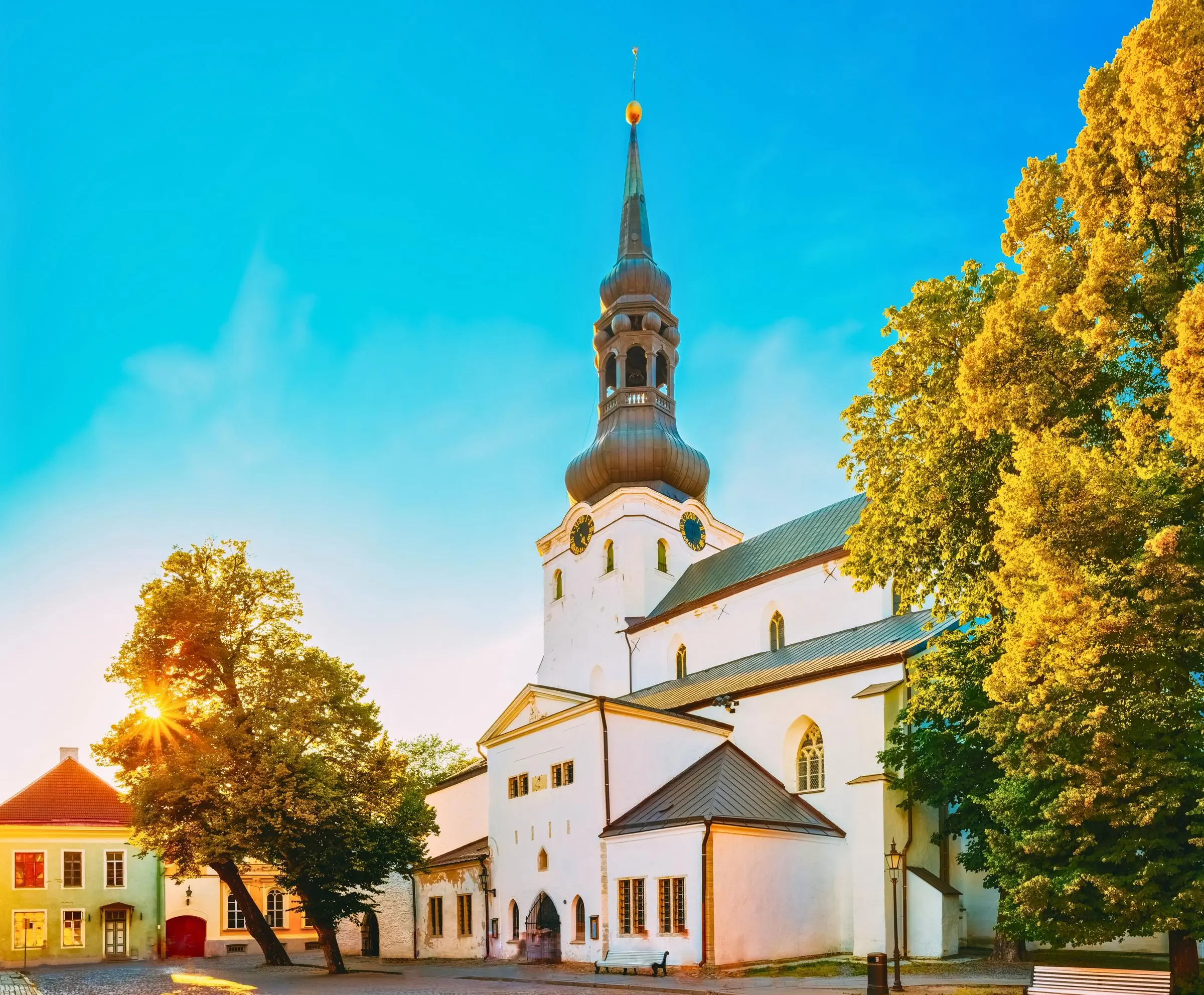
Sitting quietly in the center of Toompea Hill, St. Mary’s Cathedral (known locally as Toomkirik or the Dome Church) is the oldest church in mainland Estonia. Originally established by the Danes in the 13th century, it has survived fires, wars, and centuries of political upheaval.
Unlike the highly ornate Alexander Nevsky Cathedral just down the street, St. Mary’s presents a stark, whitewashed exterior. But step inside, and you will find a heavy, atmospheric space packed with the history of the Baltic German nobility who ruled this region for centuries.
This guide breaks down exactly what to look for inside the church, how to navigate the narrow climb to the Baroque bell tower, and the most practical ways to fit a visit into your Tallinn itinerary.
Entry to the main floor of the cathedral requires a mandatory “donation” (usually around €5), but climbing the bell tower requires a separate, specific ticket. If you plan to visit multiple museums and towers in the city, the Tallinn Card covers the tower admission.
Logistics & Traveler Advice
Because it sits in the upper part of the Old Town neighborhood, getting to St. Mary’s requires a bit of an uphill walk. You can approach Toompea Hill via the Pikk Jalg (Long Leg) ramp or the steeper, stair-heavy Lühike Jalg (Short Leg).
Here is how different types of travelers should approach a visit:
- For the Time-Poor: You only need about 15 to 20 minutes to walk the main floor, view the coats of arms, and see the sarcophagi. If you are rushing, skip the tower climb and head straight to the nearby Kohtuotsa Viewpoint for a free, ground-level panorama of the city.
- For Families with Young Children: The main floor is spacious and easy to navigate, but the bell tower is not suitable for toddlers or anyone carrying a baby. The 140 steps are steep, narrow, and spiral tightly.
- For Budget Travelers: If you just want to see the architecture, you can view the exterior for free. The mandatory donation for the interior is small, but if you are strictly watching your wallet, prioritize the free viewpoints on Toompea Hill instead of paying for the tower climb.
Quick Visit Facts
Toom-Kooli 6, Tallinn
- Hours: Generally 10:00 AM to 4:00 PM (varies by season and church services).
- Tower Access: Often closed during winter months (November to March) due to safety and weather.
- Accessibility: The main floor is accessible for wheelchairs, but the tower is strictly stairs-only.
5 Interior Structural Highlights
The interior of St. Mary’s is a mix of Gothic architecture and post-fire Baroque additions. When the great fire of 1684 swept through Toompea, it destroyed much of the church’s wooden interior, but the stone walls and vaults survived. Today, the interior is defined by five specific elements.
1. The Massive Coat of Arms Collection
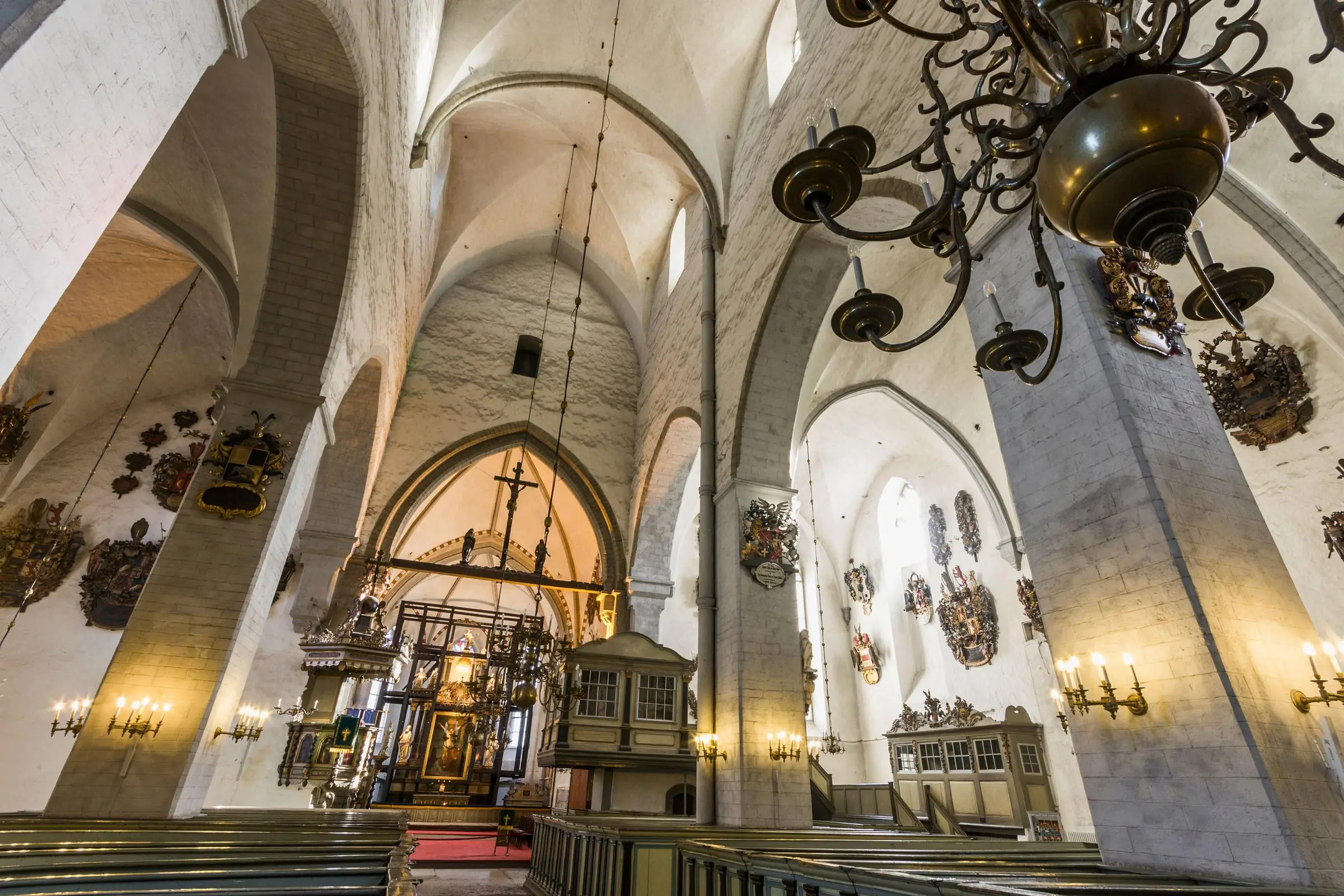
The first thing you notice upon entering is the sheer number of large, brightly painted wooden crests hanging on the white walls. These are epitaphs—funerary coats of arms belonging to the Baltic German nobility.
There are over 100 of these crests in the cathedral, dating from the 17th to the 20th centuries. When a nobleman died, his coat of arms was carried in his funeral procession and then permanently mounted on the church wall. The craftsmanship is highly detailed, featuring carved knights, mythical beasts, and intricate heraldry. They serve as a visual census of the families who controlled Estonia’s land and politics for hundreds of years.
2. Historic Stone Sarcophagi
The floor and side chapels of the cathedral are the final resting places for several notable historical figures. Rather than being buried in the ground, many were entombed in massive, elaborately carved stone sarcophagi.
Two of the most significant tombs to look for are:
- Pontus de la Gardie: A French-born Swedish military commander who died in 1585. His Renaissance-style tomb is carved from fine stone and features a detailed effigy of him and his wife, Sofia Gyllenhielm (the illegitimate daughter of King John III of Sweden).
- Adam Johann von Krusenstern: A Baltic German admiral in the Imperial Russian Navy who led the first Russian circumnavigation of the globe. His tomb is more austere, reflecting 19th-century military precision.
3. The Grand Wooden Pulpit
Following the 1684 fire, the church needed a new pulpit. The current wooden structure was carved in 1686 by Christian Ackermann, a prominent master carver in Tallinn. It is a striking example of Baroque woodcarving, featuring figures of the apostles and intricate floral motifs. The pulpit is positioned high on a pillar in the nave, designed to project the priest’s voice across the congregation before the invention of modern audio systems.
4. Sauer Pipe Organ Acoustics
If you visit on a Saturday at noon, you might hear the church’s massive pipe organ in action. Built in 1914 by the renowned German organ builder Wilhelm Sauer, the instrument boasts over 4,500 pipes. The acoustics inside the stone vaults of St. Mary’s are exceptional, carrying the deep, resonant tones of the organ perfectly down the nave. Even if you don’t catch a concert, the physical structure of the organ dominating the rear balcony is an impressive piece of early 20th-century engineering.
5. The Baroque Bell Tower Viewing Deck
The cathedral’s original tower was destroyed in the 1684 fire. The current Baroque spire, which reaches 69 meters high, was completed in 1779.
Climbing the tower is one of the main reasons visitors come to the church. The admission route takes you up 140 narrow, winding stone and wooden steps. It is a tight squeeze, and you will often have to pause to let people coming down pass by.
Once at the top, the viewing deck offers a 360-degree perspective. You can look down over the red-tiled roofs of the Lower Town, see the modern skyline in the distance, and trace the coastline of the Baltic Sea.
Tallinn Card
- Includes free entry to the St. Mary’s Cathedral bell tower.
- Coats entry to 50+ other museums and attractions.
- Includes unlimited public transport.
Secrets of Toompea Private Tour
- Private guide explaining the history of the Baltic nobility.
- Detailed breakdown of the coats of arms.
- Does not include tower ticket price.
Crowd Navigation & Local Tips
Toompea Hill is the primary target for cruise ship excursions. On summer days when multiple ships are in port, the narrow streets around the cathedral become heavily congested between 10:00 AM and 2:00 PM.
How to avoid the crowds:
- Go Early or Late: Arrive right when the church opens at 10:00 AM, or wait until after 3:00 PM when the large tour groups head back to their buses.
- Tower Traffic: The spiral staircase to the bell tower is extremely narrow. If you see a large group queuing for the tower, skip it and come back later. You do not want to be stuck on the stairs waiting for 30 people to descend.
- Combine with a Walking Tour: To fully understand the context of the church and Toompea Hill, taking a guided tour is highly recommended. A local guide can explain the complex relationship between the nobles on the hill and the merchants in the Lower Town.
A Quick Toompea Walking Route
⏱️ Total: 1 h 30 minStart at Alexander Nevsky Cathedral
Begin at the top of the hill to see the striking Russian Orthodox architecture from the outside.
Explore St. Mary's Cathedral
Walk two minutes down the street to the Dome Church. Spend 20 minutes viewing the coats of arms and sarcophagi.
Climb the Bell Tower
Head up the 140 steps for panoramic views over Tallinn.
Walk to Kohtuotsa Viewpoint
Finish your Toompea visit with a short walk to the most famous viewing platform in the city for photos.
Where to Stay Near Toompea
Staying in the Old Town neighborhood puts you within walking distance of St. Mary’s Cathedral. However, note that Toompea Hill itself has very few hotels; most accommodations are located in the Lower Town. Be prepared to walk up the hill, or take a taxi to the top if you have mobility concerns.
Keep Planning: If you are interested in Tallinn’s medieval defenses, check out our guide to the nearby Kiek in de Kök artillery tower and underground bastions.
Frequently Asked Questions
Is there a dress code for St. Mary's Cathedral?
As it is an active place of worship, modest dress is expected. Remove hats upon entering, and avoid overly revealing clothing. However, the rules are generally relaxed for tourists compared to some southern European cathedrals.
Can I take photos inside the church?
Yes, photography is allowed for personal use, but flash photography is discouraged, especially near the older wooden artifacts and paintings. Photography is strictly prohibited during church services.
Is the bell tower open in the winter?
The tower is often closed from November through March due to icy conditions, lack of heating, and safety concerns on the narrow stone steps. Always check the official notice on the door during the off-season.
How long does it take to visit?
If you are just viewing the main floor, 15 to 20 minutes is sufficient. If you are climbing the tower, allow 40 to 45 minutes total, factoring in the time it takes to navigate the narrow stairs.
Is the cathedral wheelchair accessible?
The main floor of the cathedral is accessible to wheelchairs, though the stone floors can be slightly uneven. The bell tower is absolutely not accessible, as it requires climbing 140 steep steps.
Are there guided tours available inside?
The church itself does not run regular guided tours, but many independent walking tours include a stop inside the cathedral to explain the history of the coats of arms.